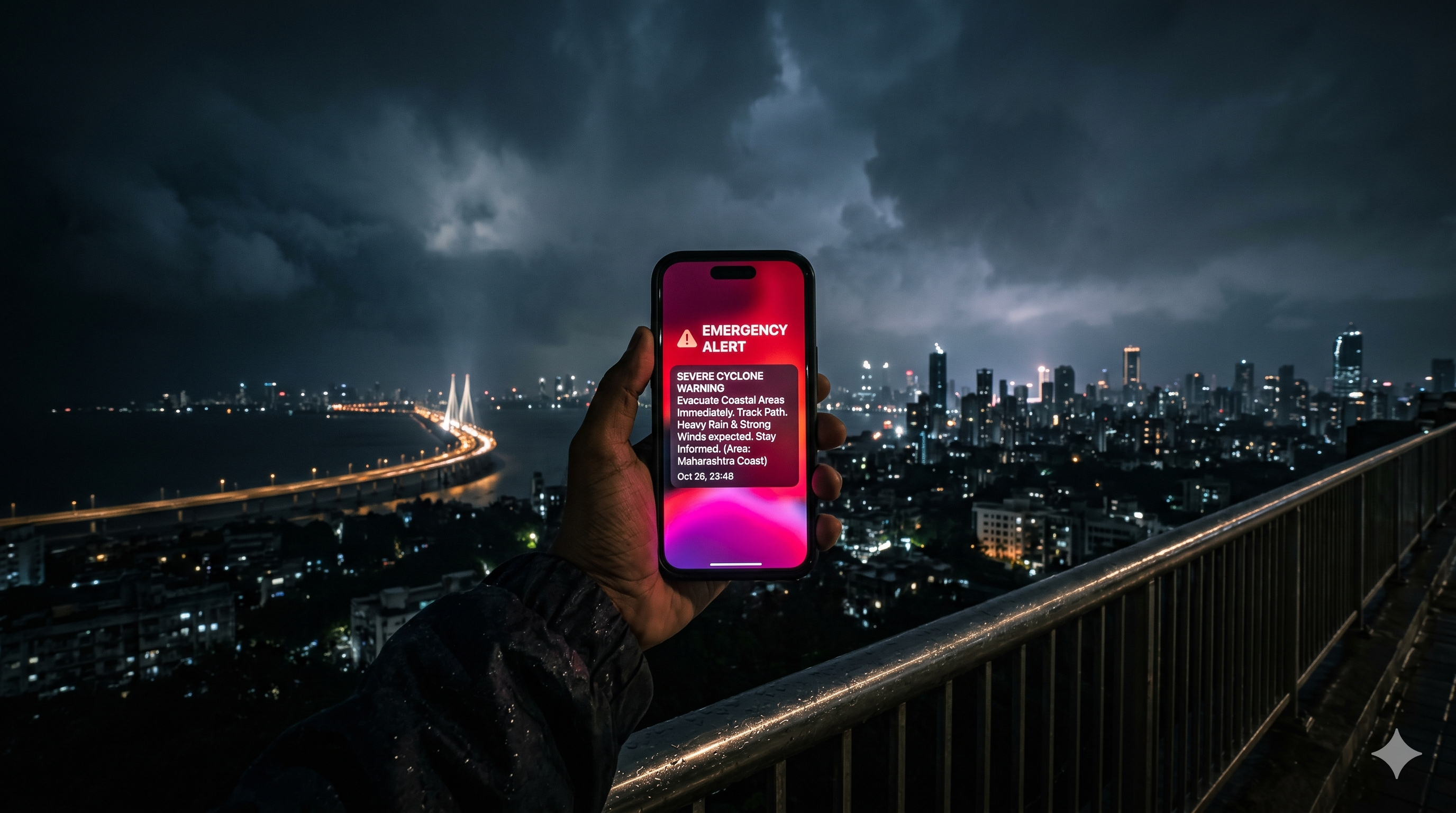
📱 If your phone just screamed at you out of nowhere — you weren't alone.
Hundreds of millions of Indians received the exact same message simultaneously today. No earthquake had struck. No cyclone was making landfall. And yet, every phone — across every network, in every corner of the country — buzzed with a jarring, loud, impossible-to-ignore alert.
The internet immediately exploded with confusion, panic, and memes. But what actually happened is far more interesting than a glitch.
India just switched on its most ambitious national emergency communication system ever — and it worked flawlessly on the very first test.
💬 THE EXACT MESSAGE PEOPLE RECEIVED: "India launches Cell Broadcast using indigenous technology for instant disaster alerting service for its citizens. Alert Citizens, Safe Nation. No action is required by the public upon receipt of this message. This is a test message. — Government of India" |
🔔 What Is Cell Broadcast — And Why Is It Different From a Normal Text?
Here's what makes this technology genuinely special, and why it's nothing like a WhatsApp forward or a government SMS blast.
A regular SMS is point-to-point — one sender, one phone number, one recipient. Cell Broadcast is something completely different:
📡 Cell Broadcast vs Regular SMS | |
Regular SMS | One sender → One recipient. Requires the recipient's number. Delivered one at a time. |
Cell Broadcast | One sender → Every device on every tower in a zone. No phone number needed. Delivered simultaneously to millions. |
Speed | Cell Broadcast reaches millions of phones in seconds. SMS would take hours at that scale. |
Internet needed? | No. Cell Broadcast works on any device connected to a cell tower — no data, no Wi-Fi required. |
Do Not Disturb? | Bypassed. The alert rings loud even if your phone is on silent or DND. |
That's why your phone screamed today even if you had Do Not Disturb enabled. The alert is hardcoded to cut through — because in a real disaster, it has to.
🏭 What Does "Indigenous Technology" Actually Mean Here?
The Government of India specifically emphasised that this system was built using indigenous technology. And that phrase is doing a lot of work.
India is not the first country to deploy Cell Broadcast. Japan, South Korea, the United States (Wireless Emergency Alerts / WEA), and most of the EU already have similar systems. But those countries built their systems using foreign technology stacks — often licensed from US or European telecom vendors.
🇮🇳 MAKE IN INDIA — FOR REAL THIS TIME The NDMA platform at the core of today's system was designed and built domestically, making India one of a small group of nations that can independently operate a national-scale emergency broadcast infrastructure without relying on foreign technology. |
This matters for two reasons:
• Strategic sovereignty — India controls the full stack. No vendor lock-in, no foreign dependencies during a national crisis.
• Scalability — The system can be upgraded, customised, and expanded by Indian engineers without licensing costs.
• Export potential — A proven homegrown Cell Broadcast platform could eventually be offered to other emerging nations.
🏗️ Who Built It? The Teams Behind the System
This was a multi-agency effort involving some of India's most critical institutions:
🔧 The Teams That Built India's Alert System | |
NDMA | National Disaster Management Authority — overall project lead and operational owner |
DoT | Department of Telecommunications — mandated all telecom operators to integrate the system |
Jio / Airtel / BSNL / Vi | All four major networks participated in today's simultaneous nationwide test |
3GPP Protocol | Internationally standardised Cell Broadcast protocol — implemented with an India-built platform layer |
📲 Why Did My Phone Scream? The Tech Explanation
Cell Broadcast alerts are designed at the OS and hardware level to override your device's normal notification settings. This isn't a bug — it's the entire point.
Here's how to manage alert settings on your device:
🤖 ANDROID USERS: Settings → Safety & Emergency → Wireless Emergency Alerts → You can disable test alerts, but keep real emergency alerts ON. |
🍎 iPHONE USERS: Settings → Notifications → Government Alerts → Toggle Emergency Alerts to stay informed. |
⚠️ Important: Cybersecurity experts and NDMA both strongly advise keeping emergency alerts enabled. Test alerts can be turned off, but disabling real disaster alerts puts you and your family at risk.
🌍 Why India Needed This — The Disasters That Changed Everything
India sits at the centre of one of the world's most disaster-prone regions. Every single year, the country faces:
• 🌀 Cyclones — on both the Bay of Bengal and Arabian Sea coastlines
• 🌊 Floods — across the Gangetic plains and Brahmaputra basin
• 🏔️ Earthquakes — along the entire Himalayan belt
• 🌧️ Flash floods and cloudbursts — increasingly frequent due to climate change
• 🏭 Industrial accidents — in the rapidly expanding manufacturing belt
The existing warning system — TV broadcasts, sirens, local officials going door-to-door — has failed catastrophically multiple times. The most haunting example: the 2004 Indian Ocean Tsunami, which killed over 10,000 people in India partly because early warning communication completely broke down.
📊 THE SCALE OF THE OPPORTUNITY India has over 900 million active smartphone users. A system that can reach all of them simultaneously — in seconds, with zero internet required — isn't an upgrade. It's a generational leap in how India protects its citizens. |
🔮 What Comes Next — The Full Roadmap
Today was a test. Here's what the NDMA has signalled is coming next:
🗓️ Cell Broadcast Rollout Roadmap | |
Phase 1 (Now) | Nationwide test completed. System validated across all four major networks. |
Cyclone Warnings | Real-time hyperlocal alerts as storms approach coastlines — replacing siren-only systems. |
Flash Flood Alerts | River basin-specific alerts tied to sensor networks and satellite data. |
Earthquake Alerts | Seconds of early warning before shaking begins — enough time to drop, cover, and hold on. |
Industrial Hazard Alerts | Chemical spill and air quality emergency alerts for urban populations near factories. |
Missing Person Alerts | India's own AMBER Alert-style system for child abduction and missing persons. |
The "Extremely Severe" classification used in today's test is the highest tier in India's disaster alert scale — a deliberate choice to ensure the alert activated on every device type, across every carrier, in every corner of the country.
It activated on all of them. The system passed.
✅ THE BOTTOM LINE
What happened on your phone today was not an accident, a glitch, or cause for panic.
It was the Indian government proving — to itself and to the world — that it can now reach every citizen, on every phone, on every network, in every corner of this enormous country, instantly, and without the internet.
In the aftermath of every major disaster, the question is always the same: why didn't people know in time? Why didn't the warning reach them?
Starting today, that question has a different answer.
🏷️ Tags: India Tech • NDMA • Cell Broadcast • Emergency Alert • Indigenous Technology • GovTech • Disaster Management • Digital India
📤 Share this story: If this article explained something you were confused about today, send it to someone who was also confused. That's how good journalism spreads.