Top 10 Financial Technology Trends of 2026 — What India and the World Must Prepare For
From agentic AI rewriting banking operations to India's UPI powering 49% of global real-time payments — here is every trend that matters, with India-specific breakdowns for each one.
📌 Quick Summary Global fintech investment reached $44.7B across 2,216 deals in H1 2025 alone. India's fintech market is valued at $51.3B in 2026, projected to reach $109B by 2031. AI adoption in finance has jumped from 37% to 59% of firms globally in just two years. H1 2026 marks a genuine inflection point — financial technology is no longer a layer on top of the financial system. It is becoming the system itself. |
$51.3B India fintech market 2026 | 49% Global real-time payments: India | 59% Firms using AI in finance | 30 Indian fintech unicorns |
Why 2026 Is Different From Every Year Before
The fintech industry has been promising transformation for a decade. In 2026, it is finally delivering. The difference is not a single breakthrough technology — it is convergence. Agentic AI, real-time payment infrastructure, digital assets with regulatory clarity, and open finance data frameworks are all maturing simultaneously, creating compounding effects that are genuinely reshaping how money moves, how credit works, and how financial services reach people.
For India specifically, this convergence is supercharged by a unique combination: the world's most advanced real-time payment infrastructure in UPI, an Aadhaar-based digital identity system covering over a billion people, and a fintech ecosystem that has collectively raised $51.1 billion over the past decade with 30 unicorns and counting.
The 10 Trends Reshaping Financial Technology in 2026
#1 🤖 Agentic AI — From Assistant to Decision Maker |
AI in fintech has crossed a critical threshold in 2026. Traditional AI tools waited for user input. Agentic AI anticipates needs based on context and takes action before being asked. Credit scoring models now update in real time based on behavioral data. Fraud detection systems learn and adapt faster than criminals can evolve tactics. Customer service has moved from chatbots answering questions to AI agents resolving complex multi-step processes independently. The global AI in fintech market is projected to reach $30 billion, growing at 22.6% CAGR, with 85% of financial institutions now using AI for core operations. 🇮🇳 India Angle: Bajaj Finserv announced a ₹400–450 crore fund dedicated to AI startups in March 2026. CRED, India's highest-funded fintech at $942M raised, is building AI-first credit intelligence. Agentic AI is entering everything from loan underwriting to fraud detection at SBI, HDFC, and major NBFCs. |
#2 💳 Embedded Finance — Every App Becomes a Bank |
Embedded finance is the idea that financial services — payments, lending, insurance — can be embedded directly into non-financial platforms. A logistics app that offers instant invoice financing. A retail platform with Buy Now Pay Later at checkout. A SaaS tool that lets freelancers get paid instantly. The "one app for everything" super app model is spreading fast. Embedded finance and open banking are exploding through multi-rail payment systems and API integrations, enabling seamless, cost-efficient transactions in non-financial platforms. 🇮🇳 India Angle: India's OCEN (Open Credit Enablement Network) framework is the infrastructure backbone for embedded lending. Digital payments already hold 42.87% of India's fintech market share. Neobanking — the fastest growing segment — is projected to grow at 19.64% CAGR from 2026 to 2031 as multi-bank UPI models expand. |
#3 🏦 UPI Evolution — Beyond Payments Into Credit |
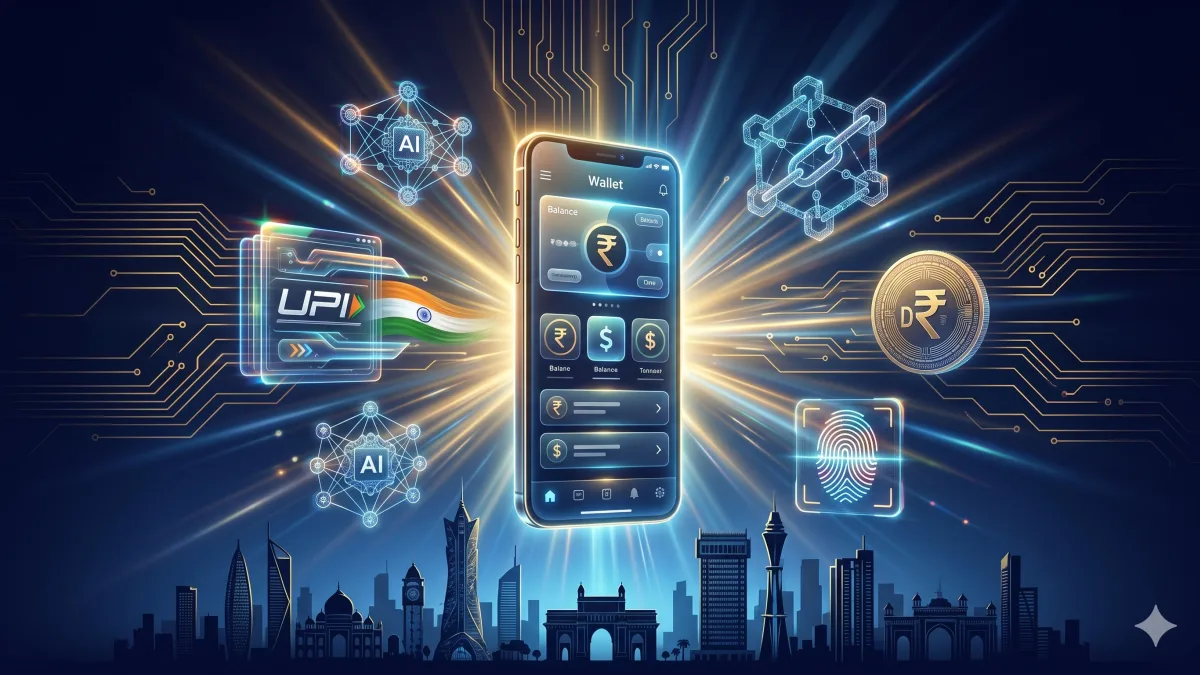
Real-time payments have become foundational infrastructure globally in 2026. Systems like FedNow in the US, SEPA Instant in Europe, and UPI in India are enabling 24/7 settlements. But India's story goes further — UPI is evolving from a payments rail into a comprehensive financial services layer. Credit is being layered onto payment infrastructure, with BNPL and small-ticket loans embedded into everyday UPI transactions. Digital wallets and buy now, pay later are no longer trends. They are the default. 🇮🇳 India Angle: India accounts for 49% of global real-time payment volumes. Over 20% of the world's real-time digital payments run through Indian systems. UPI is now powering school fees, fuel, groceries split into installments. The next phase: UPI Credit Line and UPI for international payments, already in pilot across multiple corridors. |
#4 🔗 Blockchain Tokenization — Real Assets Go Digital |
Tokenization and digital assets are revolutionizing ownership through blockchain-enabled representations of real-world assets — property, bonds, commodities, even invoices. After years of regulatory ambiguity, H1 2026 marks the beginning of a clearer, rules-based era for digital assets. The GENIUS Act in the US provides a unified legal framework for stablecoins. The EU's MiCA regulation provides a parallel comprehensive framework across all 27 EU member states. The result is a surge of institutional confidence and mainstream adoption. 🇮🇳 India Angle: India's Digital Rupee (e-RUPI) CBDC pilots are expanding. The UAE — India's largest remittance partner — has become a Real World Asset tokenization hub, directly impacting India's diaspora finance. Indian banks and NBFCs are watching stablecoin regulations closely as cross-border payment corridors evolve. |
#5 🌐 Open Finance — Your Entire Financial Life via API |
Open banking shares bank transaction data via APIs. Open finance extends this to your entire financial life — insurance policies, pension funds, mortgage data, investment portfolios. H1 2026 is the inflection point where this transition accelerates globally. Real-time personalization powered by open finance data is enabling fintechs to offer product recommendations with previously impossible accuracy. Risk modeling is improving dramatically as lenders access richer, real-time behavioral data beyond traditional credit scores. 🇮🇳 India Angle: India's Account Aggregator framework and OCEN are the world's most advanced open finance infrastructure. India's framework is being studied as a global reference model. Regulated entities can now access consented financial data across banks, insurers, and mutual funds to offer hyper-personalized products — a game changer for financial inclusion across rural India. |
#6 🛡️ RegTech — Compliance Becomes Automated |
Regulatory technology used to be a niche. In 2026, it is a standalone industry. Financial software increasingly includes RegTech capabilities directly in the stack — AML detection using machine learning, dynamic reporting tools that adapt to changing regulations, automated KYC and audit trails. A platform serving users in Europe, India, and America must deal with three distinct regulatory requirements simultaneously. RegTech makes this manageable at scale. 🇮🇳 India Angle: India's RBI has been actively shaping digital lending regulations, BNPL frameworks, and NBFC compliance requirements. Indian fintechs operating internationally face the added complexity of GDPR, MiCA, and local regulations. RegTech adoption among Indian fintech startups is accelerating as compliance costs become a competitive differentiator. |
#7 📱 Super Apps — Finance Plus Everything |
The "one app for everything" model is spreading rapidly in financial services. Super apps combine payments, investments, insurance, credit, and lifestyle services in one interface. This is particularly powerful in emerging markets where mobile is the primary — and often only — financial interface. Financial inclusion is fast becoming a fintech growth strategy. Platforms are rolling out AI-driven agents that work without a screen, via voice, in local languages, on $50 Android phones with patchy data. 🇮🇳 India Angle: Paytm, PhonePe, and CRED are India's leading super app contenders. PhonePe now handles over 50% of UPI transaction volume. India's 67.83% mobile app dominance of fintech interfaces — growing at 18.39% CAGR — makes it the perfect super app battleground. Android accounts for 70%+ of Indian smartphone users, making Android-first development critical. |
#8 🔐 Quantum-Safe Security — The Coming Encryption Crisis |
Quantum computing is transitioning from labs to boardrooms. Current RSA and elliptic-curve encryption is expected to be broken by quantum computers within the next decade. Post-quantum cryptography refers to encryption algorithms designed to resist quantum attacks. Financial data being encrypted today must stay secure for 10–20 years. Regulators in the US, UK, and EU are beginning to mandate PQC transition timelines. For financial institutions, the migration window is closing faster than most realize. 🇮🇳 India Angle: RBI and SEBI have not yet mandated PQC timelines, but Indian banks with international operations — SBI, HDFC, ICICI — must comply with US and EU mandates. Indian fintech startups building for global markets must begin PQC planning now, not when regulations arrive. |
#9 💰 India Fintech Funding — Selective but Stronger |
India's fintech sector raised $513 million across 45 funding rounds in Q1 2026, compared to $503 million across 99 rounds in Q1 2025. Funding value is up 2% but deal count fell 54%. The same capital is now concentrated across fewer, more mature companies. Seed-stage investments dropped from $72.3M to $25.7M. This "barbell effect" means capital is concentrating at late-stage and a smaller segment of early-stage, while mid-stage remains subdued. 🇮🇳 India Angle: Mumbai emerged as India's leading fintech hub in Q1 2026, capturing 61% of total investments — up from just 9% in Q1 2025. This geographic concentration signals Mumbai's growing role as India's fintech capital. Top investors: Accel and Lightspeed Venture Partners lead by deal count. |
#10 🌍 Financial Inclusion — From CSR to Growth Strategy |
Financial inclusion has stopped being a CSR checkbox and started being a fintech growth strategy. In 2026, the most innovative tools are reaching the previously unbanked — voice-based onboarding in local languages, behavioral data underwriting for gig workers with no pay slips, micro-loans delivered via apps on low-cost Android phones. Digital ID systems like India's Aadhaar are being integrated directly into fintech onboarding, enabling 30-second account creation. 🇮🇳 India Angle: India's Aadhaar-based eKYC is a global reference model. The RAMP program, supported by the World Bank through FY 2026-27, is strengthening digital onboarding for MSMEs. India's fintech revolution is explicitly reaching semi-urban and rural areas — expanding from the 640 million urban users to the next 400 million Indians who have smartphones but limited formal financial access. |
India vs World — Fintech Comparison 2026
Metric | India | Worldwide |
Market size 2026 | $51.3 billion | $394.88 billion |
Growth rate (CAGR) | 16.27% (2026–2031) | 16.2% (to 2032) |
Real-time payments share | 49% of global volume | UPI, FedNow, SEPA Instant |
Active fintech companies | 11,857 | 200,000+ globally |
Fintech unicorns | 30 | 300+ globally |
Top funding city Q1 2026 | Mumbai (61%) | New York, London, Singapore |
Biggest fintech segment | Digital payments (42.87%) | Embedded finance + AI |
Key infrastructure | UPI + Aadhaar + AA | Open banking APIs |
Fastest growing segment | Neobanking (19.64% CAGR) | Agentic AI finance |
TechPopDaily Verdict
Our Take 2026 is not just another year in fintech evolution — it is the year financial technology becomes financial infrastructure. India is uniquely positioned: it has the most advanced real-time payment system in the world, a billion-person digital identity layer, and a 30-unicorn fintech ecosystem all firing simultaneously. Whether you are a consumer, a startup founder, an investor, or a banking professional — understanding these 10 trends is not optional. The financial system is being rebuilt around them. |
Frequently Asked Questions
What is the size of India's fintech market in 2026?
India's fintech market is valued at $51.3 billion in 2026, projected to reach $109 billion by 2031 at a 16.27% CAGR. India accounts for 49% of global real-time payment volumes and has produced 30 fintech unicorns to date.
What is the biggest fintech trend of 2026?
Agentic AI is widely considered the defining fintech trend of 2026 — the shift from AI that assists users to AI that takes autonomous action on their behalf. AI adoption in financial services has jumped from 37% to 59% of firms globally in just two years.
Is India a global fintech leader?
Yes. India accounts for 49% of the world's real-time digital payment volumes, operates the most advanced national payment infrastructure (UPI), and has the Aadhaar-based identity system that is used as a global reference model for digital financial inclusion. India's fintech ecosystem is consistently ranked among the top 3 globally.
What is embedded finance and why does it matter in India?
Embedded finance means financial services — payments, credit, insurance — are built directly into non-financial apps. In India, this means BNPL at grocery checkouts, instant loans in logistics apps, and insurance in ride-hailing platforms. India's OCEN framework is purpose-built to power embedded lending at national scale.
Sources JM Financial Services • M2P Fintech • Innowise • Softjourn • IBS Intelligence • Tracxn Technologies • Mordor Intelligence • HyperVerge • SG Analytics • Avenga Last updated: May 4, 2026. Market size figures from Mordor Intelligence, January 2026. Funding data from Tracxn Geo Quarterly Report India FinTech Q1 2026. |