Nvidia Goes From 95% to 0% AI Market Share in China — 3 Ways This Could Benefit India
Jensen Huang calls it the biggest backfire in US tech policy. India's semiconductor ambitions may be the unexpected winner of this geopolitical earthquake.
📌 Quick Summary Nvidia CEO Jensen Huang confirmed the company's China AI chip market share collapsed from 95% to 0%. Nvidia took a $4.5B charge in Q1 2026. Huawei and domestic Chinese chipmakers are filling the gap. And India — with its Semiconductor Mission and growing AI infrastructure demand — stands to benefit in three significant ways. |
95%→0% Nvidia China share | $4.5B Q1 2026 charges | 66%→8% Projected drop 2024-2026 | $67B China AI chip market 2030 |
What Just Happened — The Full Story
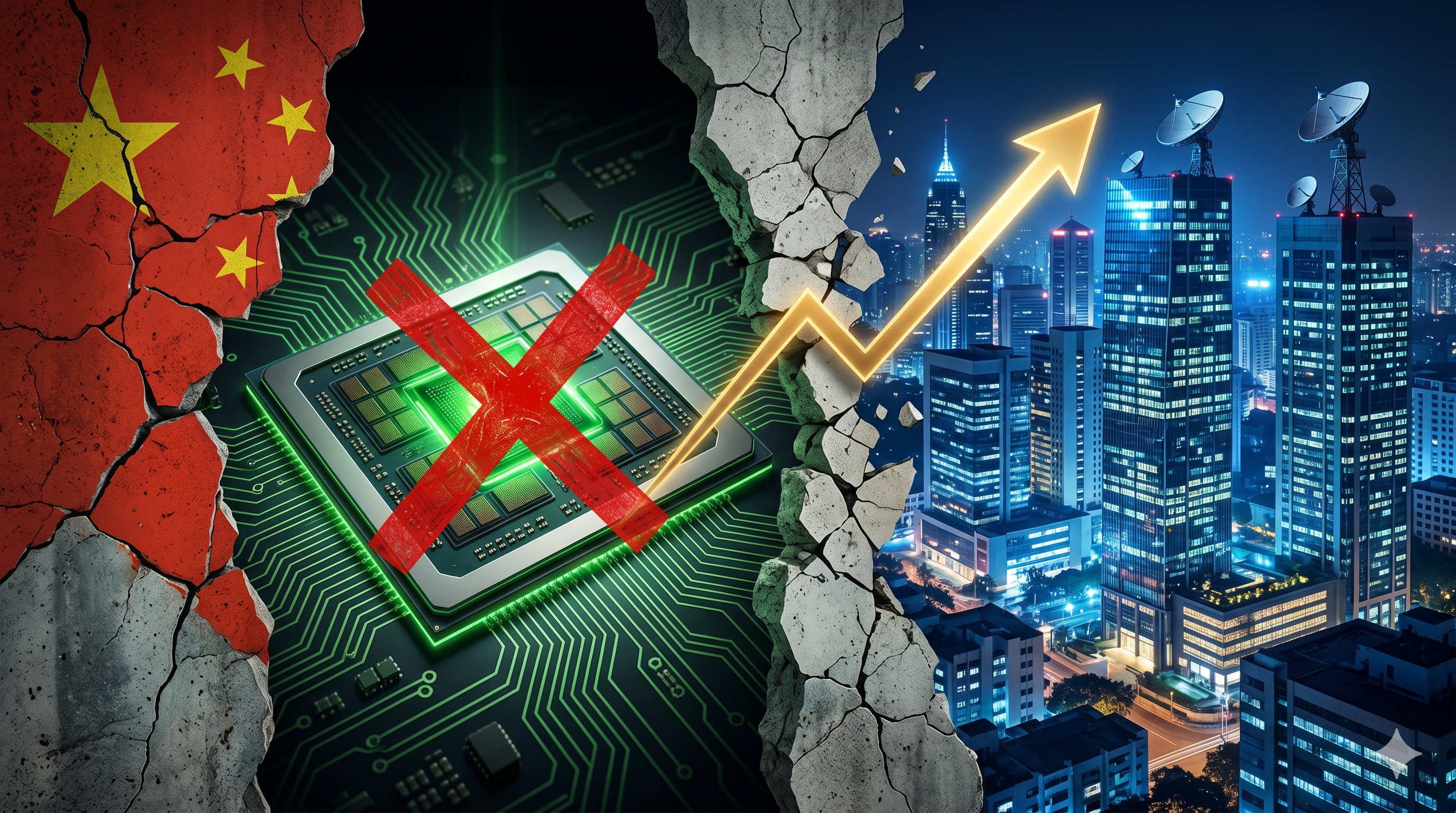
At a Citadel Securities event, Nvidia CEO Jensen Huang delivered one of the most stunning admissions in recent tech history. Speaking about his company's position in China's artificial intelligence chip market, Huang said plainly: "We went from 95% market share to 0%. In China, we have now dropped to zero."
In 2024, Nvidia controlled approximately 66% of China's AI GPU market. Bernstein analysts now project that figure will fall to just 8% in 2026. Nvidia took a $4.5 billion charge tied to export restrictions in Q1 2026 alone. China previously represented 20 to 25% of Nvidia's data center revenue — a segment generating over $41 billion in its most recent financial results.
Jensen Huang's Exact Words "In all of our forecasts, we're assuming 0% for China. If anything happens in China, it will be a bonus." He also called US export controls a policy that "has already largely backfired" — a remarkable public criticism from the CEO of America's most valuable chip company. |
How Did Nvidia Lose an Entire Market?
The collapse happened through US export controls and Chinese government policy working in opposite — but equally damaging — directions for Nvidia.
Step 1 — US Export Restrictions
The US government progressively tightened export controls on high-end AI accelerators sold to China, barring Nvidia's most advanced chips — including the Blackwell B200 and B300 — from the Chinese market entirely. Even when the US later allowed Nvidia to sell its older H200 chips to China, the damage was already done.
Step 2 — China Pushes Back
Beijing instructed Chinese tech companies to limit Nvidia chip use to overseas operations only — while directing domestic data centers to use Chinese alternatives. US regulations require Nvidia chips ordered by Chinese clients only be used inside China. These contradictory demands created a customs stalemate that froze H200 shipments entirely.
Step 3 — Chinese Alternatives Emerged
Huawei's Rise Huawei's AI chip revenue is projected to surge to $12 billion in 2026, up from $7.5 billion in 2025 — a 60% increase. Its 950PR chip entered mass production and is positioned as the dominant chip for AI inference workloads in China. Meanwhile, Cambricon posted Q1 2026 revenue of $423 million. Domestic Chinese suppliers can now satisfy approximately 80% of China's AI chip demand without Nvidia. |
3 Ways This Could Benefit India's Tech Sector
Here is where the story gets interesting for India — and why this US-China story matters deeply to every Indian in the technology sector.
1 | India becomes Nvidia's most important growth market With China effectively gone from Nvidia's revenue forecast, the company needs new markets urgently. India — with its Semiconductor Mission targeting 1 million jobs by 2026 and government-backed AI infrastructure spending — is one of the most attractive alternatives. Nvidia has already made significant commitments to India, and the China collapse only accelerates this focus. |
2 | India's semiconductor supply chain opportunity expands As the global AI chip supply chain bifurcates between US-allied and China-domestic ecosystems, India is positioned to capture significant manufacturing and assembly work. US-allied chipmakers — including Nvidia and TSMC — are actively diversifying supply chains away from China. India's young workforce, improving infrastructure, and government incentives make it a natural beneficiary of this shift. |
3 | Indian AI startups gain better access to Nvidia hardware With China no longer a competing buyer for Nvidia's most advanced GPUs, Indian AI startups, cloud providers, and universities should see improved access and GPU allocation. This could meaningfully accelerate India's AI research and commercial development over the next two to three years. |
Nvidia vs Huawei — How the Chips Compare Today
Feature | Nvidia Blackwell B200 | Huawei Ascend 950PR |
Market | Global — except China | China primarily |
AI Training Performance | Industry leading | Competitive but behind Blackwell |
Power Efficiency | High | 4x more power for same FLOPS |
Software Ecosystem | CUDA — industry standard | CANN — growing adoption |
India Availability | Yes — improving post China exit | No — China domestic only |
Export Restrictions | Freely available to India | Restricted to China market |
Price | Premium global pricing | Subsidised by Chinese government |
TechPopDaily Verdict
Our Take Nvidia's China collapse is a geopolitical earthquake that reshapes the global AI chip landscape permanently. For India, it is — counterintuitively — a significant opportunity. More Nvidia hardware availability, more supply chain investment, and stronger alignment with the world's leading AI technology ecosystem. Indian AI startups, semiconductor ambitions, and tech professionals should pay close attention. The window to capitalise on this shift is open right now. |
Frequently Asked Questions
Has Nvidia really lost all its China market share?
Nvidia CEO Jensen Huang confirmed at a Citadel Securities event that the company's AI chip market share in China has fallen from 95% to 0%. Bernstein analysts project Nvidia's share of China's AI GPU market will fall to approximately 8% in 2026 from 66% in 2024. Nvidia now assumes zero China revenue in its financial forecasts.
Is Huawei's AI chip as good as Nvidia's?
Not yet for training workloads — Huawei's chips require approximately four times more power to match Nvidia's Blackwell chips in BF16 FLOPS. However for AI inference workloads, Huawei's Ascend 950PR is increasingly competitive and is winning domestic Chinese enterprise orders rapidly.
How does this affect Indian AI companies?
With China out of the picture as a competing buyer, Indian companies should see improved access to Nvidia's most advanced GPUs. Nvidia is also significantly increasing its focus on India as a growth market. India's Semiconductor Mission and government AI infrastructure spending make the country an increasingly important Nvidia partner.
Will Nvidia recover its China market share?
Very unlikely in the near term. China's government is actively directing domestic companies toward Chinese chipmakers. Even if US export rules ease, Beijing's push for semiconductor self-sufficiency means Nvidia faces structural barriers in China regardless of US policy.
Sources Tom's Hardware • Let's Data Science • Tech4Gamers • SemiWiki • Bernstein Research via Nikkei • Financial Times • TechRadar • CryptoBriefing Last updated: May 4, 2026. All market share figures are analyst estimates. Nvidia has not officially confirmed final 2026 China revenue figures. |