
For decades, when a major company needed to transform its operations, it called McKinsey. Or BCG. Or Deloitte. It paid millions for consultants who would spend months studying the business, then hand over a report.
Anthropic just announced a plan to make that entire model obsolete.
On May 4, 2026, Anthropic launched a $1.5 billion joint venture with Goldman Sachs, Blackstone, and Hellman & Friedman — and it is coming directly for the $2 trillion global consulting industry.
💡 Did you know? For every dollar companies spend on software, they spend six dollars on services. That ratio has made consulting a multitrillion-dollar industry for decades — and it is precisely the gap that Anthropic's new joint venture is designed to capture.

What Exactly Did Anthropic Announce?
On Monday May 4, Anthropic announced a new standalone joint venture — a company that will embed Anthropic's engineers and Claude AI model directly inside mid-sized businesses to redesign their workflows from the ground up.
The founding partners and their commitments:
- Anthropic — $300 million
- Blackstone — $300 million
- Hellman & Friedman — $300 million
- Goldman Sachs — $150 million
- Apollo Global Management, General Atlantic, Sequoia Capital, GIC, Leonard Green — additional backing
Total committed capital: $1.5 billion. Total venture valuation: $1.5 billion.
The venture has not yet been officially named. But its model is clear — and it is modelled directly on one company's approach to enterprise technology.
That company is Palantir.
The Palantir Model — And Why Everyone Is Copying It
Palantir pioneered the concept of the Forward-Deployed Engineer — a software engineer embedded directly inside a client's organisation to solve real operational problems, not just install software and leave.
Anthropic's new venture follows the exact same playbook. As Anthropic put it in its official announcement: "An engagement might begin with the company's engineering team sitting down with clinicians and IT staff to build tools that fit into the workflows that staff already use."
This is not a software sale. This is AI-as-a-service delivered by engineers who live inside your business until the problem is solved. It is a model that makes the consulting industry nervous — because it combines the implementation capability of a consultancy with ownership of the underlying AI model.
Traditional consultants charge for time and advice. Anthropic's venture charges for outcomes — and owns the AI that delivers them.
💡 Did you know? Sequoia partner Julien Bek argued in April 2026 that the world's next great company will not sell software at all — it will sell outcomes: legal services, financial analysis, insurance processing — all delivered by AI and billed like consulting. Anthropic's joint venture is exactly that thesis, now capitalised at $1.5 billion.
Why Goldman, Blackstone, and Sequoia Said Yes
The financial logic of this deal is elegant — and explains why some of the world's smartest money jumped in immediately.
Blackstone manages over $1 trillion in assets across hundreds of portfolio companies. Goldman Sachs has investments spanning every industry. Apollo and General Atlantic together control hundreds of mid-sized businesses.
Every single one of those portfolio companies needs AI transformation. Every single one lacks the in-house engineering talent to do it properly.
The joint venture gives these investors a guaranteed, preferred pipeline for AI services across their entire portfolio — while also capturing the economic upside as the venture expands beyond their own companies.
As Anthropic's head of product for financial services Nicholas Lin put it: "There's a big gap between what AI can do today and the value the market is truly getting from it." The venture is explicitly designed to close that gap — starting with the PE-owned mid-market, then expanding outward.
Anthropic vs OpenAI — The Race to Own Enterprise AI
Here is the detail that turns this from an interesting business story into a genuine AI industry inflection point.
Within hours of Anthropic's announcement, Bloomberg reported that OpenAI is finalizing a nearly identical venture — called "The Development Company" — raising $4 billion from 19 investors at a $10 billion valuation. Backers include TPG, Brookfield, Bain Capital, and Advent.
Both ventures follow the forward-deployed engineering model. Both target mid-sized companies. Both use their respective AI models — Claude for Anthropic, GPT-4o and beyond for OpenAI — as the core product.
The race to own enterprise AI deployment is now officially on. And the prize is enormous.
| Anthropic JV | OpenAI — The Development Company | |
|---|---|---|
| Total capital | $1.5 billion | $4 billion |
| Valuation | $1.5 billion | $10 billion |
| AI model used | Claude | GPT-4o / GPT-5 |
| Key partners | Goldman, Blackstone, Sequoia | TPG, Brookfield, Bain |
| Target market | PE-owned mid-market | Broader enterprise |
| Model | Forward-deployed engineers | Forward-deployed engineers |
| IPO timeline | 2026 possible | 2026 possible |
What Does This Mean for the Consulting Industry?
This is the question that McKinsey, Bain, and BCG are quietly asking right now.
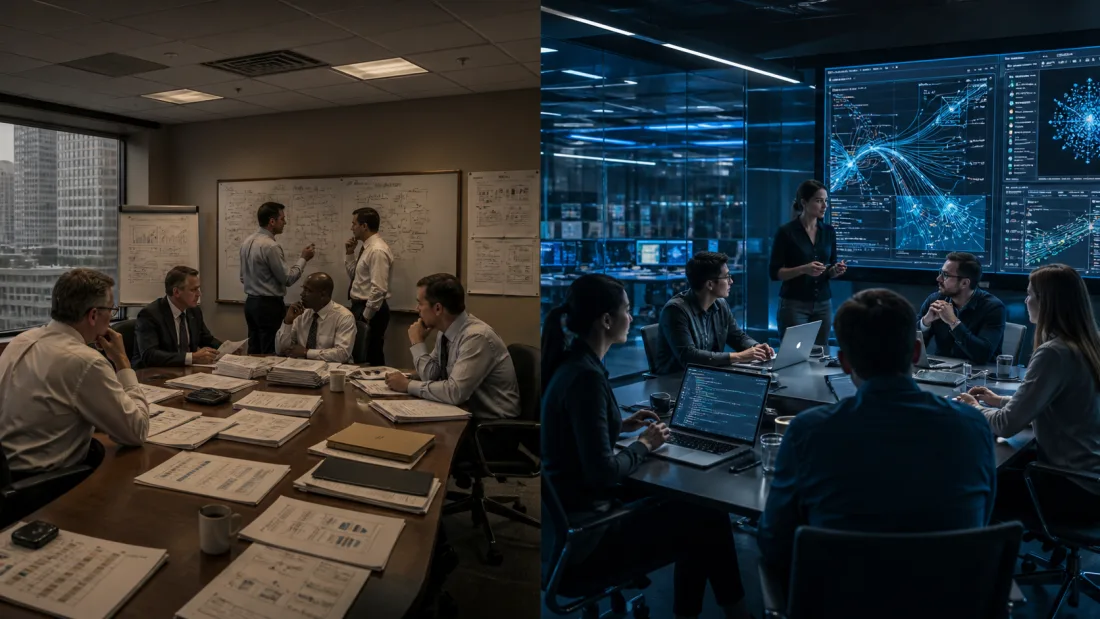
Traditional management consulting works because companies need expertise they do not have in-house. Consultants provide that expertise — at significant cost, over significant time, with results that are often difficult to measure precisely.
AI-native ventures like Anthropic's joint venture and Palantir's FDSE model offer something different: engineers who build the actual solution inside your business, powered by AI that can analyse data, automate workflows, and generate insights at a scale no human consultant can match — and at a speed that traditional firms cannot replicate.
Fortune described the Anthropic venture as putting the company "in direct competition with the world's largest consulting firms for the lucrative business of corporate AI transformation."
The consulting industry is not going to disappear overnight. But the economics of the business — six dollars of services for every dollar of software — are about to face the most serious challenge in decades.
💡 Did you know? Anthropic's venture is specifically targeting healthcare, manufacturing, financial services, retail, and real estate — the five sectors where PE-owned mid-sized companies are most concentrated and where AI workflow transformation has the clearest ROI.
What About Claude — The AI Behind All of This?
Claude is Anthropic's flagship AI model — the product that will be deployed inside every company the joint venture works with.
Claude is widely regarded as one of the three most capable large language models available in 2026, alongside OpenAI's GPT-4o and Google's Gemini Ultra. It is particularly strong at complex reasoning, long-context document analysis, and safe, reliable outputs in enterprise environments.
The joint venture is essentially a massive, well-funded distribution channel for Claude — giving Anthropic direct access to hundreds of mid-sized companies through Blackstone's and Goldman's portfolio, while building a track record of enterprise deployments that strengthens Claude's position against OpenAI and Google in the enterprise market.
For Anthropic — which is preparing for a possible IPO as early as late 2026 — this is both a revenue strategy and a competitive moat.
What This Means for Jobs
The honest answer is that this kind of AI deployment, done at scale, will automate significant portions of white-collar work in the sectors it targets.
Anthropic's venture is explicitly going after healthcare administration, financial analysis, manufacturing operations, retail workflows, and real estate processes — all of which currently employ large numbers of analysts, coordinators, and process managers.
This does not mean mass layoffs happen overnight. Enterprise AI transformation typically takes 12 to 24 months per company. But the direction of travel is clear: fewer people doing repetitive knowledge work, more AI doing it faster and cheaper.
The companies that will gain are the ones that move first. The workers who will thrive are the ones who learn to work alongside the AI — not against it.
✅ TechPopDaily Verdict
Anthropic's $1.5 billion joint venture with Goldman Sachs, Blackstone, and Sequoia is one of the most significant AI business moves of 2026. It signals that the AI industry has moved past the "build the model" phase and into the "deploy the model at scale inside real businesses" phase — and that the financial industry is betting enormous capital on that transition happening fast. For businesses, the message is clear: AI transformation is no longer optional, and the companies with the best implementation support will pull ahead. For the consulting industry, the clock is ticking. And for Anthropic, this is the deal that turns a research lab into a genuine enterprise technology company.
Frequently Asked Questions
What is Anthropic's joint venture? Anthropic's joint venture is a $1.5 billion standalone company formed with Goldman Sachs, Blackstone, Hellman & Friedman, and several other Wall Street investors. It embeds Anthropic engineers and Claude AI directly inside mid-sized businesses to redesign their workflows and automate operations — competing directly with traditional management consultants.
Who are the partners in Anthropic's joint venture? The founding partners are Blackstone, Hellman & Friedman, and Goldman Sachs — each contributing $300 million, $300 million, and $150 million respectively. Additional backers include Apollo Global Management, General Atlantic, Sequoia Capital, Singapore's sovereign wealth fund GIC, and Leonard Green.
How is Anthropic's venture different from regular software? Traditional software is installed and left for companies to use on their own. Anthropic's venture embeds engineers directly inside businesses to build customised AI solutions — a model popularised by Palantir called Forward-Deployed Engineering. This means the venture competes with consultants, not just software companies.
Is OpenAI doing the same thing? Yes. Within hours of Anthropic's announcement, Bloomberg reported that OpenAI is finalizing a similar venture called "The Development Company" — raising $4 billion at a $10 billion valuation from investors including TPG, Brookfield, and Bain Capital. Both ventures follow an identical forward-deployed engineering model.
What does this mean for jobs in consulting? Anthropic's venture directly targets the work that management consultants currently perform — workflow analysis, process redesign, and operational transformation — using AI to do it faster and cheaper. The consulting industry is not disappearing overnight, but the economic model that has sustained it for decades is facing its most serious challenge yet.