Why Hearing Aid Technology Is Trending in 2026
Search interest in hearing aid technology has surged over 750% in the US in May 2026 — and for good reason. A combination of breakthrough AI processing, over-the-counter (OTC) availability, and a new generation of discreet, nearly invisible designs has fundamentally changed what hearing aids can do and who can access them.
Whether you're researching for yourself or a family member, this guide breaks down the biggest developments in hearing aid technology in 2026 and what to look for when choosing a device.
AI-Powered Hearing: The Biggest Leap Yet
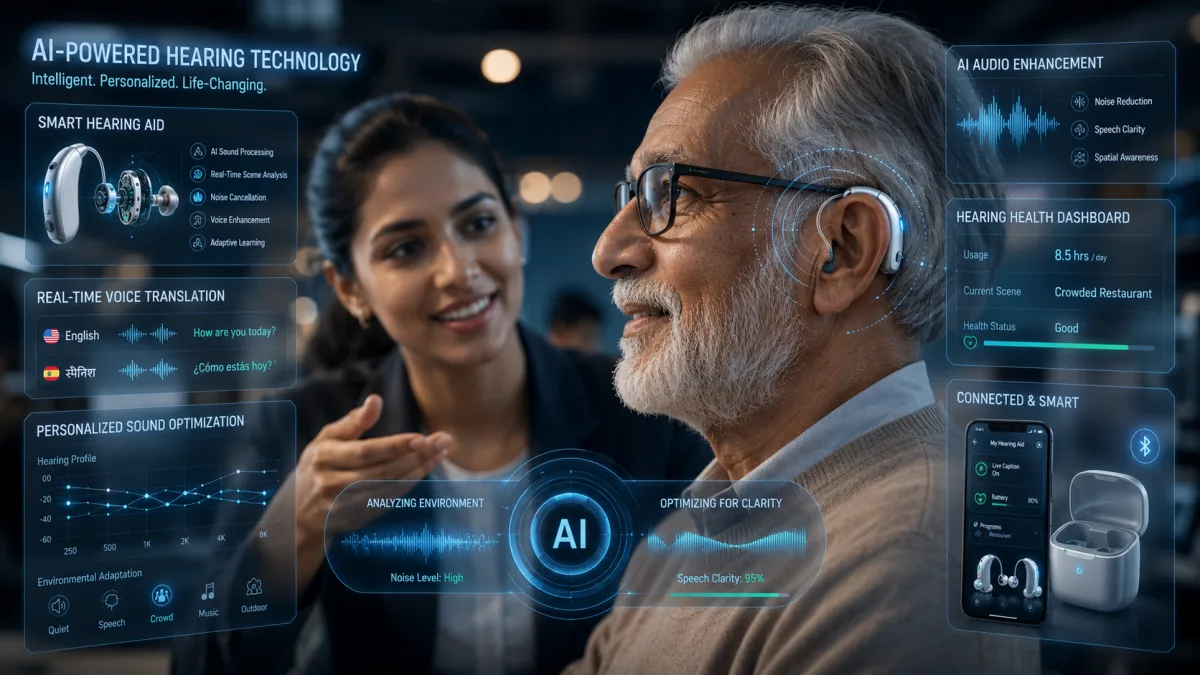
The single biggest advancement in 2026 is the integration of on-device AI sound processing. Unlike older hearing aids that simply amplified all sound, modern AI-powered devices can:
- Separate speech from background noise in real time — even in crowded restaurants or busy streets
- Adapt automatically to different environments (office, outdoors, music, phone calls) without manual adjustment
- Learn your preferences over time, adjusting EQ and noise cancellation based on your usage patterns
- Detect falls and send emergency alerts — a feature now found in premium models from Starkey and Phonak
- Translate languages in real-time via Bluetooth connection to a smartphone — useful for travellers and professionals
Top Hearing Aid Technology Brands in 2026
The market in 2026 is more competitive than ever. Here are the leading players:
- Starkey Genesis AI: The most advanced AI chipset in any hearing aid; best-in-class for speech clarity and fall detection. Premium pricing (~$5,000–$7,000 per pair).
- Phonak Lumity 2: Outstanding Bluetooth connectivity and AutoSense AI that identifies 200+ acoustic environments. Strong choice for active users.
- Oticon Intent: Uses a "brain-like" processing approach that mimics how the human brain naturally prioritises sound. Excellent for severe hearing loss.
- Jabra Enhance Plus: OTC device with solid AI noise cancellation at under $1,500 — disrupting the traditional audiologist model.
- Apple AirPods Pro (Hearing Aid Mode): FDA-approved in 2024 for mild-to-moderate hearing loss; now the go-to for tech-savvy users who already own AirPods Pro 2.
Over-the-Counter Hearing Aids: A Game Changer for Access
Since the FDA opened the OTC hearing aid market in the US in 2022, prices have dropped dramatically. In 2026, quality OTC options are available for $300–$1,500, compared to $4,000–$8,000 for prescription devices. This has made hearing assistance accessible to the estimated 38 million Americans with hearing loss who previously could not afford treatment.
Key OTC brands to know:
- Lexie B2 Plus: Subscription-based model ($49/month) including ongoing support
- Sony CRE-E10: Self-fitting, app-controlled, trusted brand recognition
- Jabra Enhance Select 500: Strong telehealth support built in
What to Look For When Buying a Hearing Aid in 2026
With so many options, here's a practical checklist:
- Severity of hearing loss: OTC devices suit mild-to-moderate loss; severe loss still benefits from professional audiologist fitting
- Bluetooth connectivity: Essential if you want to stream audio from your phone, TV, or computer directly
- Battery life: Rechargeable lithium-ion is now standard; aim for 20+ hours per charge
- Tinnitus management: Many 2026 models include built-in white noise or sound therapy for tinnitus relief
- App support: A companion app for fine-tuning settings is increasingly important
- Trial period: Most reputable providers offer 30–60 day trials; never buy without one
The Future of Hearing Aid Technology
Looking beyond 2026, the trajectory is clear: hearing aids are converging with consumer earbuds, health monitoring wearables, and AI assistants. Within 5 years, the distinction between a premium hearing aid and a high-end earbud may disappear entirely.
Research into gene therapy for hearing loss is also showing early promise, with trials in 2025 demonstrating partial restoration of natural hearing in some patients — suggesting that technology may one day treat the root cause rather than compensate for it.
Final Thoughts
Hearing aid technology in 2026 is genuinely exciting — not just as a medical device, but as a window into how AI can enhance everyday human experience. If you or someone you know has been putting off addressing hearing loss, the options available today are better, smaller, and more affordable than ever before.
For more coverage of health tech, AI, and gadgets, explore TechPopDaily.