
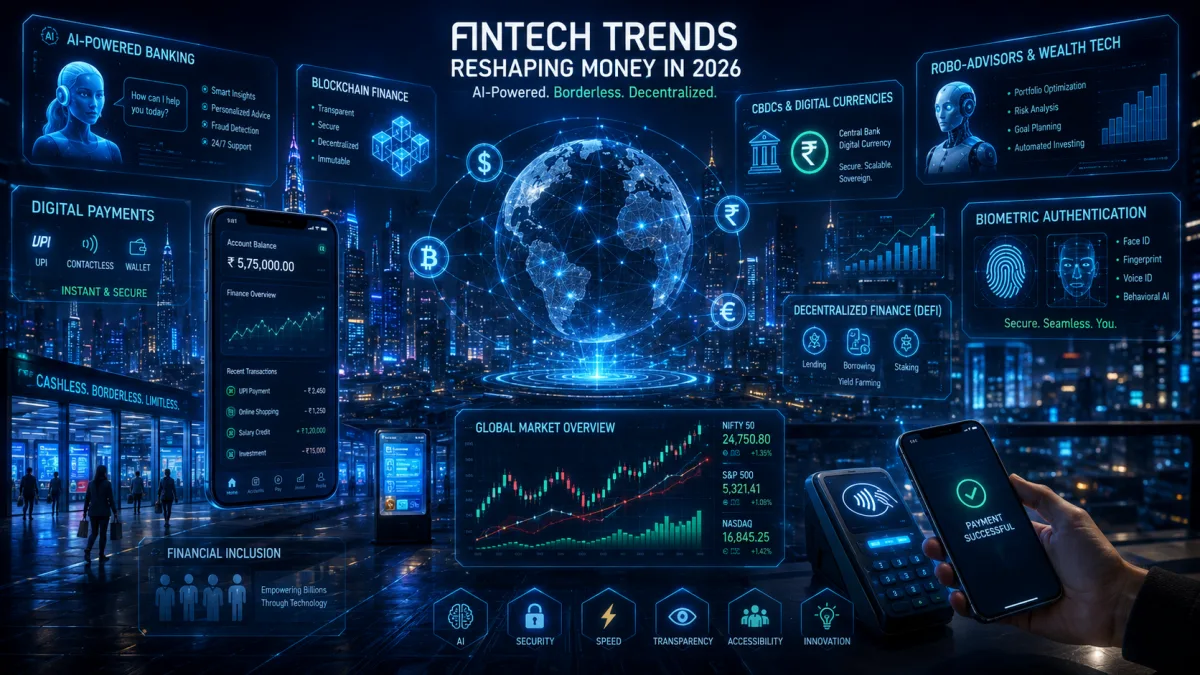
Why Financial Technology Is Having Its Biggest Year Yet
Search interest in financial technology trends has climbed 60% in the US in 2026, and globally the FinTech sector continues to attract both venture capital and mainstream adoption at scale. After a period of correction and consolidation in 2023–2024, the industry has emerged leaner, more focused, and — critically — more embedded in everyday financial life than ever before.
Whether you are a consumer, entrepreneur, investor, or policy maker, these are the financial technology trends that will define the rest of 2026 and shape the decade ahead.
1. AI-Native Banking: Beyond Chatbots
The first wave of AI in banking gave us chatbots and basic fraud detection. The 2026 wave is different — AI-native banks are building their entire stack around machine learning, from underwriting and credit scoring to personalised financial advice.
- Startups like Zest AI and Upstart are replacing traditional FICO-based credit models with AI systems that approve more borrowers at lower default rates
- JPMorgan Chase's LLM-powered research assistant now handles analysis tasks that previously required teams of analysts
- Indian neobanks like Jupiter and Fi are deploying AI spend coaches that proactively alert users to anomalous spending before they notice it themselves
2. Embedded Finance: When Every App Becomes a Bank
Embedded finance — the integration of financial services into non-financial platforms — is the defining FinTech story of 2026. Every e-commerce platform, ride-hailing app, and SaaS business now wants to offer payments, lending, and insurance natively.
- Shopify Balance gives merchants a business account, card, and instant payouts without a traditional bank
- Uber offers driver micro-loans based on earnings history — approved and disbursed in seconds
- In India, Juspay's BaaS (Banking as a Service) platform powers the financial layer for dozens of super-apps
- Global embedded finance revenue is projected to hit $230 billion by 2028, up from $65 billion in 2023
3. Central Bank Digital Currencies (CBDCs) Go Live
2026 is the year CBDCs move from pilot to mainstream. Key developments:
- India's Digital Rupee (e₹): Now live across 50+ cities with over 5 million active wallets; RBI targeting 50 million users by FY2027
- China's Digital Yuan: Processed over $1 trillion in transactions cumulatively; being integrated into Belt and Road trading corridors
- EU Digital Euro: Finalised legislative framework in 2025; phased retail rollout begins in late 2026
- US: The Federal Reserve remains in research phase, but political pressure is building as allies and rivals advance
4. Open Banking Matures Globally
Open banking — where banks must share customer data (with consent) via APIs — has moved beyond Europe into India, Australia, Brazil, and Southeast Asia. In 2026, the next phase is open finance, extending data sharing to investments, insurance, and pensions.
This creates enormous opportunities for FinTech apps to offer truly holistic financial views and act as the user's single financial control centre — aggregating data across banks, mutual funds, credit cards, and insurance policies.
5. RegTech: Compliance Gets Automated
Regulatory Technology (RegTech) is one of the most underhyped FinTech trends. With global financial regulation growing in complexity — from crypto rules to ESG disclosures to anti-money laundering requirements — financial institutions are turning to AI-powered compliance tools.
- Real-time transaction monitoring using ML to detect AML patterns 10x faster than rule-based systems
- Automated KYC/KYB using facial recognition, document scanning, and behavioural biometrics
- ESG reporting automation — a necessity for institutions under the EU's CSRD requirements
6. Buy Now, Pay Later (BNPL) Grows Up
After the high-growth, high-risk early years, BNPL in 2026 is a mature, regulated segment. New developments include:
- BNPL data now flowing into credit bureaus in most major markets — affecting credit scores
- Responsible lending regulations in India, UK, and Australia have reduced defaults but also pruned growth
- B2B BNPL — trade financing for businesses — is the new growth frontier, with companies like Resolve and Mondu scaling rapidly
7. Crypto and DeFi: Institutional Adoption Accelerates
Despite volatility cycles, institutional crypto adoption is at an all-time high in 2026:
- Bitcoin ETFs in the US have crossed $150 billion in AUM within two years of launch
- Tokenised real-world assets (RWAs) — representing bonds, real estate, and commodities on blockchain — have reached $20 billion in total value locked
- Major banks like BlackRock, JPMorgan, and Goldman Sachs now offer crypto custody and tokenised fund products
What FinTech Means for You in 2026
The practical implication of all these trends is simpler financial lives. Lower fees, faster transactions, smarter insights, and more accessible credit. Whether you are managing personal savings or running a business, the tools available in 2026 are vastly superior to anything available five years ago.
To stay ahead of financial technology developments, explore more on Indian tech stocks and blockchain technology at TechPopDaily.