Blockchain in 2026: The Post-Hype Era
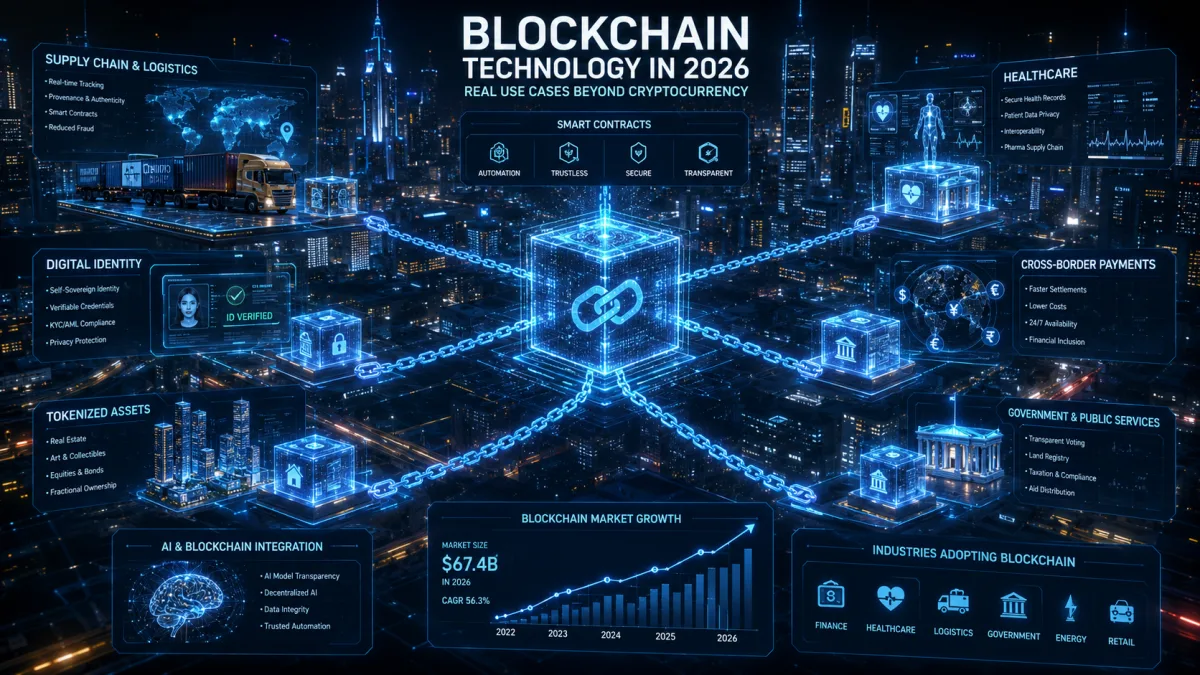
For years, blockchain technology was either breathlessly over-hyped or dismissed as nothing more than the infrastructure for speculation. In 2026, we have finally entered the post-hype era — a quieter, more productive phase where blockchain is quietly solving real problems in supply chains, healthcare, finance, and government, without most users even knowing it's there.
Search interest in blockchain technology remains steady globally — up 20% in the US in 2026 — but more importantly, the nature of searches has shifted: people are looking for applications, not just prices. That shift tells you everything about where the technology has arrived.
1. Supply Chain: The Killer App for Blockchain
If blockchain has one undisputed killer app in 2026, it's supply chain transparency. The ability to create an immutable, shared ledger of every step a product takes — from raw material to retail shelf — addresses a trillion-dollar problem of counterfeiting, fraud, and inefficiency.
- Food safety: Walmart, Carrefour, and Nestlé use IBM Food Trust (blockchain-based) to trace produce from farm to store in seconds, not days. A contamination event that previously took 7 days to trace now takes 2.2 seconds
- Luxury goods: LVMH's AURA blockchain platform authenticates Louis Vuitton, Bulgari, and Dior products — each item has a digital passport on-chain
- Pharmaceuticals: The US Drug Supply Chain Security Act now effectively requires blockchain-level traceability for prescription drugs, driving adoption across the pharma industry
2. Digital Identity: Owning Your Own Data
The concept of Self-Sovereign Identity (SSI) — where individuals hold and control their own verified credentials on a blockchain — is moving from academic papers to government deployments.
- The EU's European Digital Identity Wallet (mandated for all member states by 2026) uses blockchain-anchored verifiable credentials for passports, driving licenses, and professional qualifications
- India's National Blockchain Strategy envisions DigiLocker evolving into a blockchain-based credential store for land records, education certificates, and health data
- Microsoft's Entra Verified ID product is helping enterprises issue and verify tamper-proof employee credentials

3. Healthcare: Records That Finally Follow You
Medical records fragmentation costs the US healthcare system an estimated $8.3 billion annually in duplicate tests and errors. Blockchain offers a solution: a patient-controlled, interoperable health record that any authorised provider can access.
- Estonia's e-Health system — already blockchain-secured — is cited globally as the gold standard for health data sovereignty
- MedRec (MIT-developed) and similar systems are in active pilots across US hospital networks
- Pharmaceutical clinical trial data integrity: blockchain timestamps trial data, preventing retroactive manipulation — a significant issue in the industry
4. Tokenisation of Real-World Assets
Tokenised assets — representing ownership of physical or financial assets as blockchain tokens — are one of the most transformative financial technology trends of 2026, as discussed in our FinTech trends analysis.
- BlackRock's BUIDL fund tokenised $500 million in US Treasuries on Ethereum in 2024 — now expanded to $2 billion
- Real estate tokenisation platforms allow fractional ownership of properties from $100 — democratising an asset class previously limited to the wealthy
- Carbon credits are being tokenised to create transparent, verifiable markets for emissions trading
5. Cross-Border Payments: Faster, Cheaper, Transparent
Traditional international wire transfers are slow (2–5 days), expensive (3–7% fees), and opaque. Blockchain-based systems are dismantling this model:
- Ripple's XRP Ledger processes cross-border payments in 3–5 seconds at near-zero cost; over 100 financial institutions are live on RippleNet
- Stellar network powers remittances for underbanked populations across Africa, Southeast Asia, and Latin America
- SWIFT's blockchain integration project now enables real-time settlement across 200+ member banks
6. Government and Voting
Blockchain-based voting systems are in active deployment:
- Sierra Leone, Colombia, and several US counties have piloted blockchain voting for binding elections
- Land registry on blockchain in Georgia (the country), Honduras, and India's Andhra Pradesh reduces title fraud and speeds up property transfers from weeks to hours
The Bottom Line on Blockchain in 2026
Blockchain technology in 2026 is infrastructure — unglamorous, often invisible, but increasingly foundational. Like the internet protocols that power every website without users thinking about them, blockchain is embedding itself into the systems that govern supply chains, identities, money, and records.
The question is no longer "is blockchain real?" — it's "which of the 50 platforms building on it will become the standard?" That's a healthier, more productive question, and the answer is emerging rapidly.
For more on the intersection of blockchain and finance, visit our FinTech trends 2026 guide. Stay updated with all tech developments at TechPopDaily.