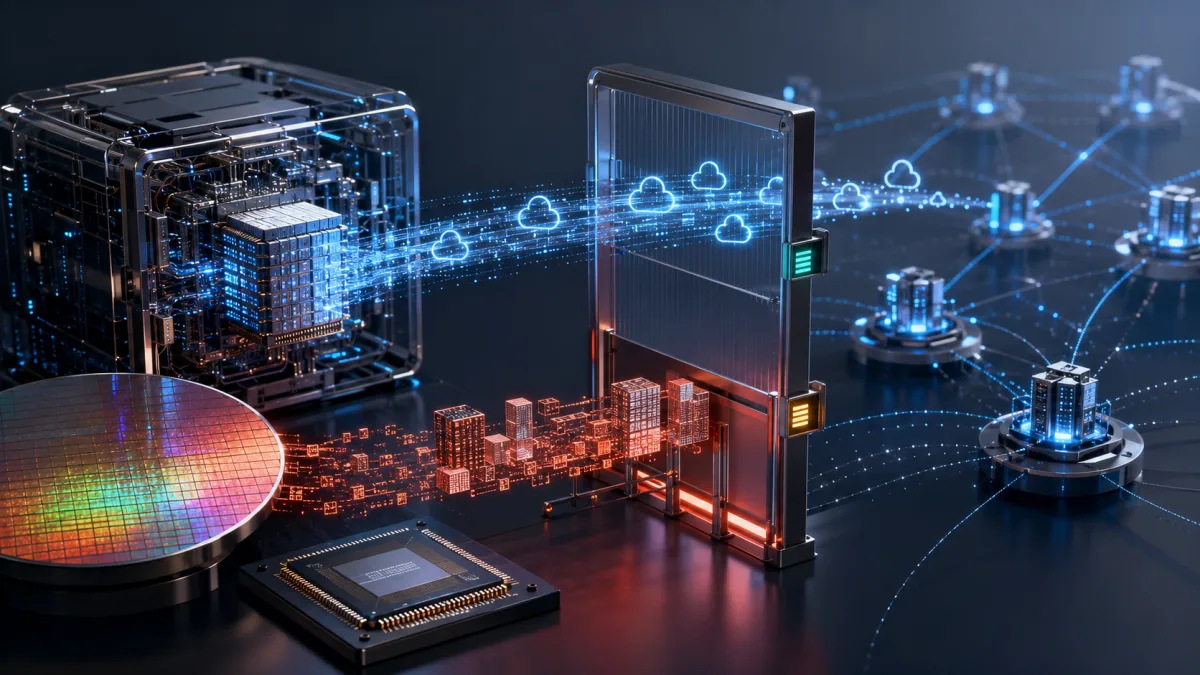
Jeff Bezos has made some extraordinary bets over his career — Amazon Web Services, Blue Origin, The Washington Post. His latest is arguably the most ambitious: $12 billion poured into what he calls an "artificial general engineer" — an AI system designed not to chat or write code, but to physically redesign how complex objects are built. Jet engines. Pharmaceuticals. Semiconductors. Everything. Here's what this actually is, and why it could matter more than the chatbot race everyone is watching.
What Is an "Artificial General Engineer"?
The term sounds like science fiction, but Bezos is talking about something specific: an AI system capable of understanding the full design and manufacturing constraints of complex physical products and generating novel, better-performing designs that humans wouldn't conceive of unaided. Think of it as the engineering equivalent of what AlphaFold did for protein structure — it didn't just catalog known structures, it predicted new ones that opened entire new fields of drug discovery.
According to June 2026 reporting, Bezos's investment targets physical AI — the category of AI that operates in and on the physical world, not just the digital one. This is a category that's received billions of dollars in 2026 alone from Germany to Barcelona, as global manufacturers race to bring AI off the screen and into the factory. Humanoid robotics companies like Figure, 1X, and Agility Robotics are all part of this wave, but Bezos's bet is more specifically on design intelligence than robot bodies.
Why This Is Different From Other AI Investments
Most AI investment in 2026 targets software: writing, coding, customer service, data analysis. These are high-value markets, but also intensely competitive — OpenAI, Google, Microsoft, and Anthropic are all fighting for the same ground. Physical world engineering design is a different problem: the data is proprietary (locked inside manufacturing companies), the validation is slow (you have to actually build and test the thing), and the expertise required is scarce.
Statista reports that the global engineering services market is valued at over $1.2 trillion annually. If an AI system could design 20% better jet engines, 30% more efficient drug delivery mechanisms, or semiconductors with novel architectures that no human team would generate, the economic value isn't in the AI subscription fee — it's in the products themselves. This is why Bezos's bet, if it works, is different in kind from a ChatGPT competitor.
This connects to the broader physical AI wave we've tracked in our coverage of how AI is reshaping traditional industries in 2026. The pattern is consistent: AI moves from playing games (Chess, Go) to scientific domains (protein folding) to engineering design.
Who Else Is Playing in Physical AI?
Bezos is not alone. SpaceX is pitching investors on AI compute that may eventually leave Earth — designing rockets and satellite systems via AI at scale. Germany and Spain are pouring government funds into physical AI research centers. Nvidia's Jensen Huang explicitly called 2026 the year of "physical AI" at CES, arguing that the next decade of AI value will come from robots and automated design systems, not from chatbots.
China's $295 billion AI infrastructure push also has a significant physical AI component focused on manufacturing automation. This means Bezos's $12 billion bet is entering a global race, not an empty field. The US-China competition in physical AI is arguably as consequential as the semiconductor competition — whoever can design better physical products faster will have a manufacturing advantage that compounds over decades.
The Timeline and What to Watch
Physical AI is slower to validate than software AI. A chatbot can be tested by millions of users in days. A redesigned jet engine component takes years of testing, certification, and production ramp. This means the $12 billion investment will not generate visible results for 3–5 years at minimum. But Bezos has shown with Amazon and Blue Origin that he's willing to invest on 10+ year time horizons in ways that most investors won't.
Watch for partnerships with major aerospace, pharma, and semiconductor companies: those are the validation signals that the technology is working. If Boeing, Pfizer, or TSMC publicly announce design partnerships with Bezos's physical AI venture, that's when the bet starts to look like a winning one.
What This Means for You
If you work in engineering, manufacturing, or physical product design, this is the most important AI development to follow in 2026 — it's coming for your domain's design process before it comes for your job, and the companies that integrate it early will outcompete those that wait. If you're an investor, note that the physical AI sector is less crowded and more defensible than software AI — proprietary manufacturing data and slow validation cycles create natural moats. If you're simply curious, the Bezos physical AI bet is the highest-stakes test of whether AI can genuinely solve problems that humans have struggled with for generations.
Frequently Asked Questions (FAQs)
Q: What is Jeff Bezos investing $12 billion in for physical AI in 2026?
A: Bezos is backing what he describes as an "artificial general engineer" — an AI system designed to autonomously redesign complex physical products like jet engines, pharmaceuticals, and semiconductors in ways that improve performance beyond what human engineering teams would generate.
Q: What is physical AI and how is it different from regular AI?
A: Physical AI refers to AI systems that operate in or redesign the physical world — robots, autonomous vehicles, manufacturing design systems — rather than purely digital outputs like text or code. Physical AI requires understanding real-world constraints like material properties, manufacturing tolerances, and physics.
Q: Which companies are investing in physical AI in 2026?
A: Nvidia, SpaceX, Figure AI, 1X Technologies, and Agility Robotics are all major physical AI investors in 2026. Governments in Germany, Spain, and China are also funding physical AI research centers. The sector received billions in investment in H1 2026 globally.
Q: How long before Bezos's physical AI investment shows commercial results?
A: Physical AI validations are slower than software AI — engineering redesigns require years of testing, regulatory certification, and production validation. Analysts expect the first commercially significant results from Bezos's physical AI investments to emerge in the 2029–2031 timeframe at earliest.
Jeff Bezos doesn't make small bets. The $12 billion physical AI investment is either going to look prescient — a bet on the next wave of AI value that most investors missed — or it's going to be the most expensive engineering experiment of the decade. Given his track record with AWS, Blue Origin, and Alexa, the smart money shouldn't dismiss this one.