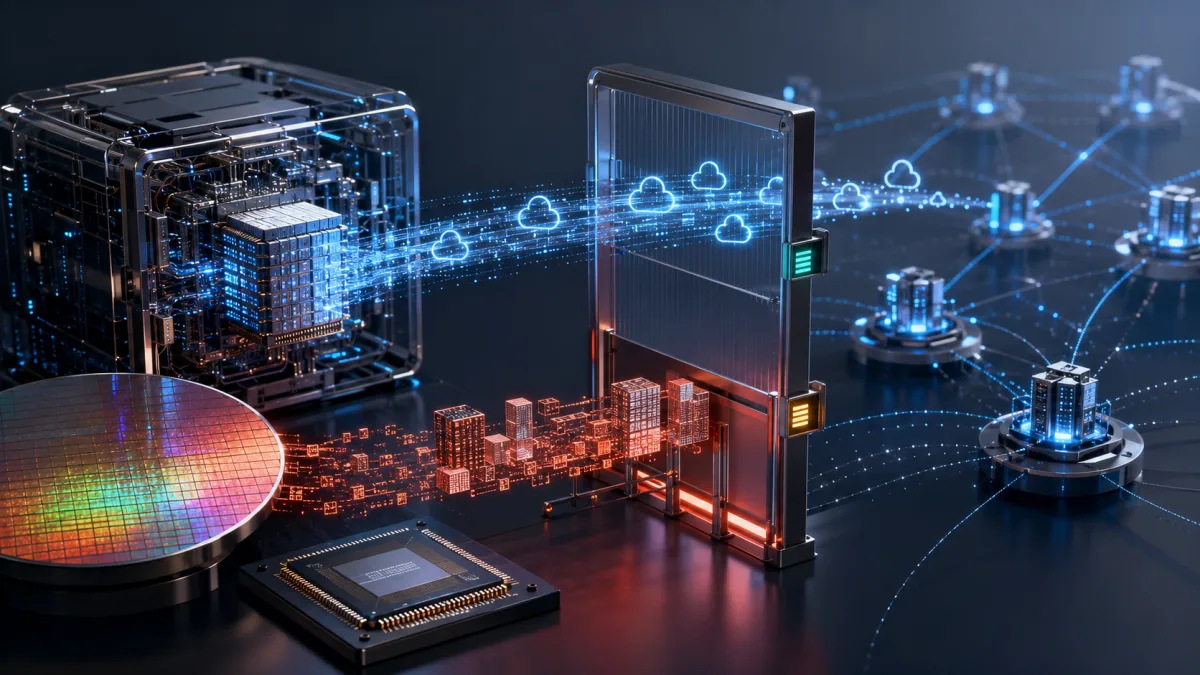
The global AI race has stopped being about models and started being about money — enormous, nation-state-scale money. China has announced a $295 billion AI infrastructure push. America's OpenAI has told investors it will spend $600 billion on compute by 2030. Alphabet just announced $80 billion in AI infrastructure spending. Add it up and you're looking at nearly $1 trillion in AI capital deployment from publicly disclosed plans alone. Here's who's ahead, what the race means for the rest of the world, and where India fits in this picture.
The American Side: Private Capital Building at National Scale
The US approach to AI infrastructure is fundamentally private-sector led, fragmented across multiple competing companies, and driven by capital markets rather than state planning. The Stargate project — a $500 billion joint venture between SoftBank, Oracle, and OpenAI — is the most visible example, aiming to build AI data centers across the United States at a scale that would make it the largest single compute infrastructure project in history.
Alphabet announced plans to raise $80 billion through a stock offering specifically to fund AI infrastructure, compute capacity, and global data center expansion. Microsoft, AWS, and Meta are spending tens of billions annually on similar expansions. The combined US private-sector AI infrastructure spending in 2026 is estimated to exceed $150 billion, according to infrastructure analysts cited in June 2026 Tech Startups reporting.
The structural advantage of the US approach: competitive pressure drives efficiency, and private capital only flows toward things that can generate returns, creating natural discipline on deployment. The structural risk: fragmentation means coordination is hard, and geopolitical adversaries can observe and target specific company infrastructures more easily than state-owned systems.
The Chinese Side: State Coordination at Scale
China's $295 billion AI infrastructure plan is different in kind: state-directed, coordinated across multiple provincial governments and state-owned enterprises, and explicitly designed to ensure China is not dependent on American AI infrastructure — whether chips, models, or cloud services. The plan covers data centers, domestic semiconductor development, AI model training clusters, and the energy infrastructure to power all of it.
The ambition is to create a complete domestic AI stack — from chip design (via Huawei's Ascend processors and SMIC's manufacturing) to model training, cloud services, and AI applications — fully operational without any US components. Whether this is achievable on the $295 billion budget and stated timeline is debated; semiconductor analysts argue that China's manufacturing capabilities remain 2–3 generations behind TSMC's leading processes, which constrains training infrastructure performance significantly.
What China has achieved in AI that's underreported: its application-layer AI deployment — facial recognition, logistics optimization, smart city infrastructure, and industrial AI in manufacturing — is often more advanced than comparable Western deployments at scale. China has 1.4 billion people and an industrial manufacturing base that generates enormous real-world AI training data that most Western AI companies can't access.
Where India Stands in the Global AI Capital War
Between the two superpowers, the rest of the world faces a structural choice: align with US AI infrastructure (and the regulatory, data sovereignty, and geopolitical strings attached) or seek alternative paths. The EU is attempting a third way — the AI Act imposes regulatory requirements that apply to any AI system used in Europe, creating leverage over both US and Chinese AI providers.
India's position is particularly interesting. The Indian government has not chosen sides — it uses Google, Microsoft, and AWS cloud services while maintaining diplomatic and economic relationships with China. India's own AI infrastructure investments, including the IndiaAI Mission's ₹10,000 crore allocation for sovereign AI compute, are modest by comparison but strategically significant: they represent an attempt to build domestic AI capability without full dependence on either superpower's infrastructure.
For Indian startups and enterprises, the practical reality is that US AI infrastructure — AWS, Google Cloud, Azure — remains the most accessible and technically advanced option available. As we covered in our analysis of Google's AI Immersion Program for Indian startups, the deepening relationship between Indian AI companies and US cloud providers is accelerating rapidly. But the AI capital war being fought above them will shape pricing, availability, and geopolitical risk through the rest of the decade.
The Energy Equation: Who Can Actually Power This Much AI?
The least-discussed constraint in the global AI capital war is power. OpenAI has described 10-gigawatt AI compute ambitions — the equivalent of 10 nuclear power plants, dedicated entirely to AI. China's $295 billion plan similarly requires massive energy infrastructure expansion. The global AI boom is already straining power grids in Northern Virginia (the world's largest data center hub), Singapore, and several Chinese provinces.
Both the US and China are investing in energy infrastructure alongside compute infrastructure: nuclear power, solar, and natural gas expansion are all being accelerated to power AI. This energy demand creates cascading effects on global power markets, semiconductor cooling technology demand, and climate commitments — AI's carbon footprint at 2030 scale will be enormous without aggressive clean energy deployment. India, which has significant renewable energy ambitions of its own, could position its clean energy surplus as an AI infrastructure advantage in the coming decade.
What This Means for You
For Indian businesses and consumers: the AI tools you use today are being built on infrastructure financed by this capital war. Disruptions, price changes, or access restrictions in that infrastructure would flow directly to you. For Indian policymakers, the argument for the IndiaAI Mission's sovereign compute investment is precisely to reduce this dependency. For global investors, the AI infrastructure spend is real and durable — power companies, cooling technology providers, and data center REITs are indirect beneficiaries regardless of which AI model wins the quality race. For US and European businesses, check your AI vendor concentration: if all your AI tools run on a single cloud provider, you have geopolitical concentration risk that didn't exist five years ago.
Frequently Asked Questions (FAQs)
Q: How much is China spending on AI infrastructure in 2026?
A: China has announced a $295 billion AI infrastructure push covering data centers, domestic semiconductor development, AI model training clusters, and energy infrastructure. The plan is state-directed and designed to create a fully domestic AI stack independent of US components.
Q: How much is the US spending on AI infrastructure in 2026?
A: US private-sector AI infrastructure spending in 2026 is estimated to exceed $150 billion annually, with the Stargate project (OpenAI, SoftBank, Oracle) targeting $500 billion total over its lifetime. Alphabet alone announced an $80 billion stock offering specifically for AI infrastructure. OpenAI told investors it plans to spend $600 billion on compute by 2030.
Q: How does the global AI race affect India in 2026?
A: India navigates the US-China AI competition without fully aligning with either side. Indian businesses rely on US AI infrastructure (AWS, Google Cloud, Azure) for most services, while the government is investing ₹10,000 crore through the IndiaAI Mission in sovereign compute infrastructure. Indian startups are primarily building on US AI platforms and benefiting from programs like Google's AI Immersion Initiative.
Q: Is China's AI as advanced as America's in 2026?
A: In frontier model training and chip design, China remains 1–2 generations behind US capabilities, partly due to export controls limiting access to advanced semiconductors. However, in AI application deployment — manufacturing, logistics, facial recognition, and smart city infrastructure — China's scale of real-world deployment often surpasses comparable Western applications.
Q: What is the IndiaAI Mission and how much is India investing in AI?
A: The IndiaAI Mission is a government initiative with approximately ₹10,000 crore ($1.2 billion) planned to build domestic AI compute infrastructure and capability. While modest compared to US and Chinese spending, it represents India's effort to develop sovereign AI capacity and reduce dependence on foreign infrastructure.
The AI capital war is not a spectator sport — it's the infrastructure race that will determine which AI tools are available, at what price, and with what strings attached, for the rest of the decade. The US-China competition is defining the landscape, the EU is regulating from the edges, and India is making smart but underfunded bets on sovereign capability. Where this ends up in 2030 will look very different from anything anyone is predicting today.