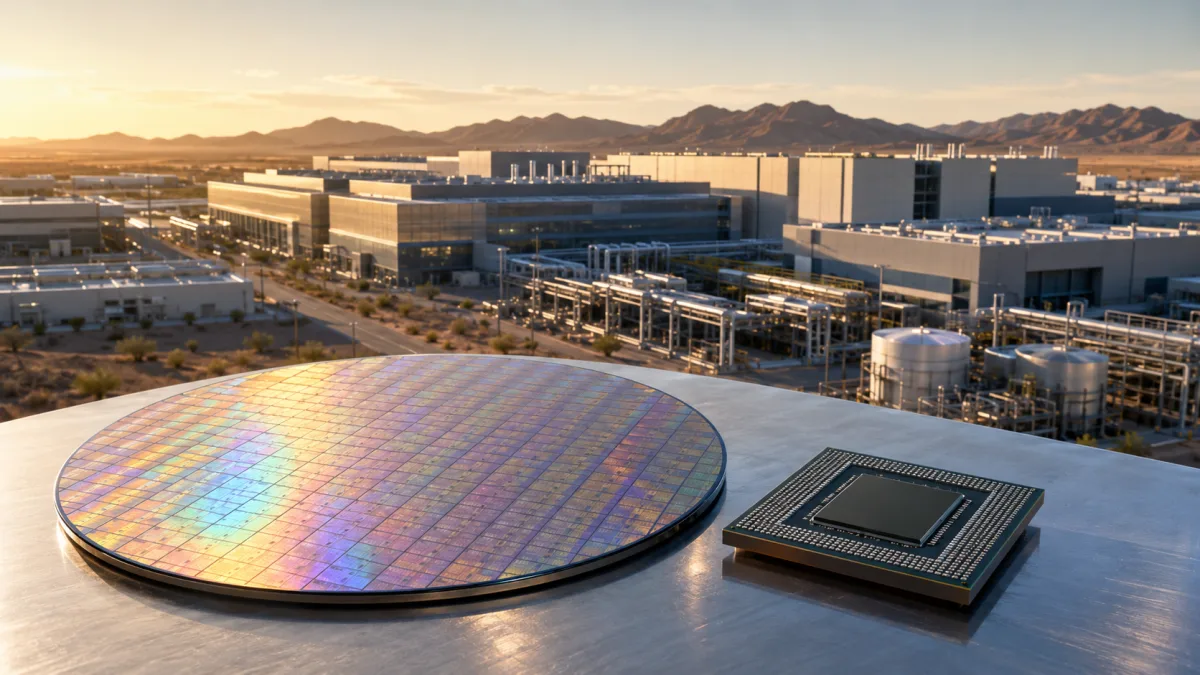
Silicon History Is Being Written at 2 Nanometers
AMD has begun volume production of its sixth-generation EPYC server processor, codenamed Venice—crossing a threshold the semiconductor industry has been working toward for nearly a decade. Venice is the world's first high-performance computing product manufactured on TSMC's N2 (2-nanometer) process node, unlocking performance-per-watt gains that previous nodes could not deliver. AMD holds approximately 35% of the server CPU market, so the ripple effects through the data center ecosystem will be substantial.
What 2nm Actually Means in Practice
TSMC's N2 delivers approximately 15% better performance at the same power level as N3, or equivalently, 25–30% better power efficiency at the same performance. For a data center operator running thousands of servers 24/7, that efficiency gain translates directly to reduced electricity costs and cooling load. AMD's Venice specifically offers core counts up to 192 per socket—a 50% increase over Turin—and memory bandwidth improvements of approximately 40% enabled by HBM4 integration in selected SKUs. For AI inference workloads, which are both memory-bandwidth-constrained and power-sensitive, Venice represents a step-function improvement.

The Intel Question
AMD's arrival at 2nm comes as Intel continues navigating a protracted manufacturing transition. Intel's competing server line remains on Intel 18A (roughly equivalent to TSMC 3nm), and the company has been cautious about committing to external foundry manufacturing at scale. The gap between AMD and Intel on process technology, which closed significantly between 2020 and 2023, has widened again. Intel's response, articulated at its March 2026 investor day, is to compete on system-level integration—accelerators, networking, and storage bundled with CPU—rather than on raw process technology.
Cloud Providers Are Already Lining Up
AWS, Google Cloud, and Oracle have each confirmed Venice-based instances in their 2026 roadmaps, with general availability expected in Q3. AWS's internal benchmarks show Venice-based instances delivering 28% better price-performance on database workloads compared to current-generation Turin instances. For compute-intensive workloads, the gap approaches 35%.

For Enterprise Buyers: When to Refresh
For enterprises planning server refreshes in late 2026 and 2027, Venice-based systems represent a compelling investment—both for immediate performance gains and energy efficiency improvements that are increasingly relevant as data center power costs rise across North America. The combination of 192-core density, HBM4 memory bandwidth, and 2nm efficiency makes Venice the strongest AMD data center product in the company's history, and potentially the strongest server CPU from any vendor until Intel's next major architecture ships.