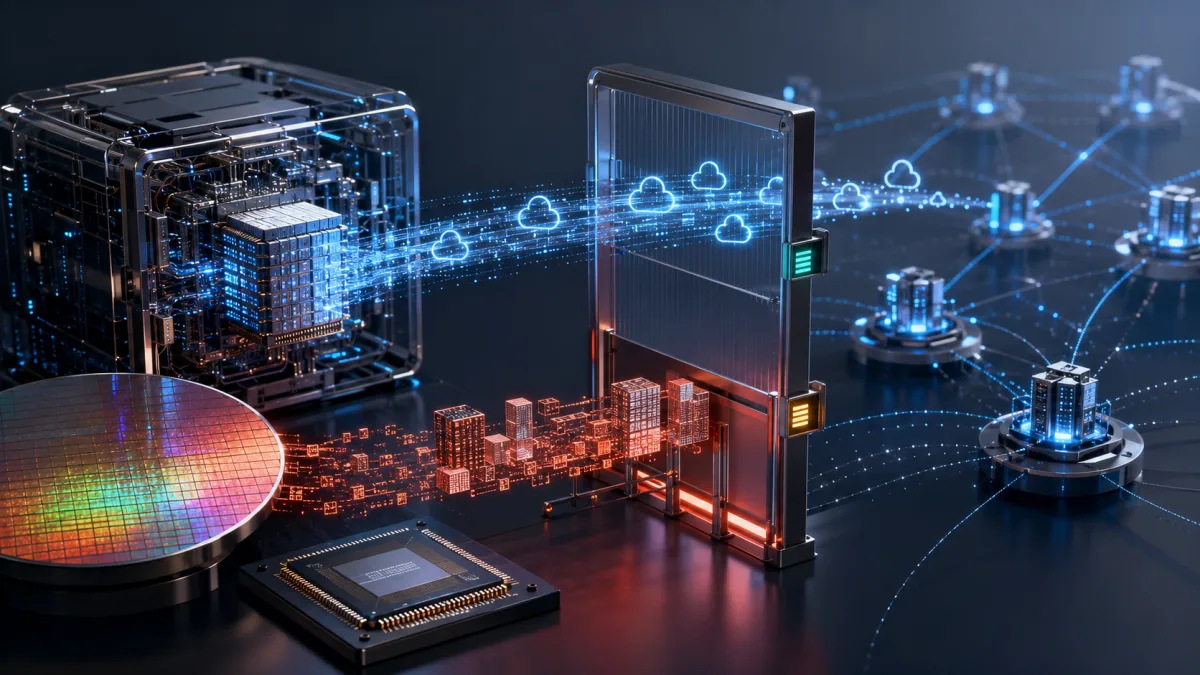

Every AI answer you get has a hidden price tag paid in electricity — and in 2026, that bill is coming due. The same data centers powering the AI boom are now straining power grids from Virginia to Maharashtra, forcing a reckoning that few in the industry want to discuss out loud. In this piece you'll learn how much electricity AI actually consumes, why Google's own power use jumped sharply, how the US and India are responding differently, and what the energy crunch means for the future of AI — and your electricity bill.

The number Big Tech doesn't advertise
Google's 2025 environmental report revealed a 37% year-over-year increase in electricity consumption, driven primarily by AI infrastructure expansion, with its data centers consuming over 42 million megawatt-hours. That's not a rounding error — it's a structural shift. The International Energy Agency has warned that global data center electricity demand is on track to roughly double as AI workloads scale. Training and running large models is enormously power-hungry, and every new AI feature bolted onto search, office software and phones adds to the load. The AI industry's growth curve is, quietly, an energy-demand curve.
US vs. India: two responses to the same crunch
The contrast in how regions are coping is revealing. In the United States, AI data center clusters in states like Virginia have become so power-hungry that utilities are delaying coal-plant retirements and racing to add capacity, pushing up local electricity prices. India, building its AI infrastructure later, is trying to leapfrog — pairing its compute push with renewables and situating data centers near solar and wind capacity. India's own compute expansion, which we detailed in the IndiaAI Mission's GPU programme, will test whether a country can scale AI without repeating the West's fossil-fuel bind. Both regions face the same physics: more compute means more power.
Why efficiency gains aren't keeping up
Chips are getting more efficient per operation, so why is total consumption soaring? It's the classic rebound effect: as AI gets cheaper and better, demand explodes faster than efficiency improves. NVIDIA's newer GPUs do more work per watt, but companies simply deploy far more of them. Add agentic AI — systems that run continuously in the background rather than answering one query at a time — and the always-on power draw climbs further. This is the flip side of the enterprise AI rush we covered in Microsoft's $2.5B Frontier bet: every deployment is also an energy commitment.

What to watch next
Three fronts will decide how this plays out. First, the nuclear and renewable buildout — tech giants are signing deals for nuclear power and large solar arrays to feed data centers. Second, regulation: expect governments to weigh data-center energy rules and grid-impact disclosures. Third, efficiency breakthroughs in cooling and chip design that could bend the curve. Watch whether AI's energy demand outpaces clean-energy supply; if it does, the environmental cost of the AI boom becomes a mainstream political issue, not a footnote in a sustainability report.
What This Means for You
If you're a consumer, expect AI's energy appetite to eventually show up in electricity prices, especially near large data-center hubs — and expect "green AI" to become a marketing claim worth scrutinizing. If you run a business using AI, factor energy and sustainability into vendor choices; efficiency and clean-power sourcing are becoming real differentiators. And if you're a policymaker or citizen, the key question is whether AI's growth is matched by clean-energy investment. The technology isn't slowing down, so the grid and the generation mix have to keep up.
Frequently Asked Questions (FAQs)
Q: How much electricity does AI actually use?
A: A lot and rising fast. Google's 2025 environmental report showed a 37% year-over-year jump in electricity use, driven by AI, with its data centers consuming over 42 million megawatt-hours. The IEA expects global data center demand to roughly double as AI scales.
Q: How is India handling AI's energy demand?
A: India is building much of its AI infrastructure later than the West and is trying to pair its compute expansion, like the IndiaAI Mission, with renewables and data centers sited near solar and wind, aiming to avoid a heavy fossil-fuel dependence.
Q: Why are US electricity prices rising near data centers?
A: In US states like Virginia, AI data centers consume so much power that utilities are delaying plant retirements and adding capacity, which can push up local electricity prices for households and businesses.
Q: Can AI become more energy efficient?
A: Chips are improving per-watt performance, but total consumption keeps rising because cheaper, better AI drives explosive demand — a rebound effect. Breakthroughs in cooling, chip design and clean-power sourcing are the main hopes for bending the curve.
AI's intelligence runs on electricity, and 2026 is the year that cost stopped being invisible. Whether the boom stays sustainable depends on clean energy keeping pace with compute. Watch the nuclear deals and the grid data. Does AI's energy footprint change how you feel about it? Tell us in the comments and share this with someone who's never thought about where AI's power comes from.